
English translation of Murat Turan’s article on Turkish law. Turkish institutions, statutory references and the author’s legal assessments are retained. Translated court extracts are not official English translations. The original Turkish graphics are reproduced with English captions.
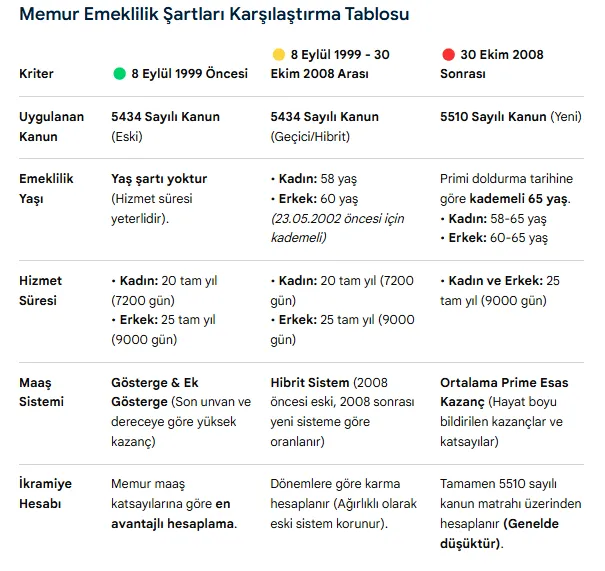
The retirement conditions applicable to public officials (civil servants) vary according to their date of entry into service and sex. Although the general position is outlined in the table below, subordinate rules and exceptions make social security legislation increasingly complex. The principal reason for this complexity in our social security legislation is the repeated introduction of fundamental reforms and the transitional rules adopted to protect the rights of existing employees during those reforms. Although Türkiye’s social security system appears to have been brought together under a single institution, the Social Security Institution (Sosyal Güvenlik Kurumu — SGK), behind it lies an extensive maze of laws, dates and employment statuses.
Comparison Table: Retirement Conditions for Civil Servants
Original table reproduced from the Turkish article. It compares retirement conditions by date of entry into service and sex; the applicable regime and exceptions are discussed in the article.
View the original Turkish comparison table at full size
English Translation of the Original Table
The dates and classifications below reproduce the original Turkish table.
Criterion | Before 8 September 1999 | 8 September 1999–30 October 2008 | After 30 October 2008 |
|---|---|---|---|
Applicable law | Law no. 5434 (earlier regime) | Law no. 5434 (transitional/hybrid regime) | Law no. 5510 (new regime) |
Retirement age | No age requirement; the service period is sufficient. | Women: 58; men: 60. Graduated requirements for the period before 23 May 2002. | Gradually rises to 65, depending on when the required contribution period is completed. Women: 58–65; men: 60–65. |
Service period | Women: 20 full years (7200 days). Men: 25 full years (9000 days). | Women: 20 full years (7200 days). Men: 25 full years (9000 days). | Women and men: 25 full years (9000 days). |
Pension calculation system | Indicator and supplementary indicator: higher pensionable earnings according to final title and grade. | Hybrid system: periods before 2008 are calculated under the earlier system and periods after 2008 proportionately under the new system. | Average earnings subject to contributions: lifetime declared earnings and coefficients. |
Retirement bonus calculation | The most advantageous calculation using civil servant salary coefficients. | Mixed calculation according to the relevant periods; the earlier system is largely retained. | Calculated entirely on the basis prescribed by Law no. 5510; generally lower. |
By way of background, although Law no. 5510 on Social Insurance and General Health Insurance, which entered into force at the beginning of October 2008, changed the State Retirement Fund (Emekli Sandığı) system, the provisions of Law no. 5434 continue to apply to retirement entitlements, pension calculations and retirement bonus conditions for persons who first entered the civil service or equivalent public service before 15 October 2008 (civil servants or Fund participants covered by the earlier regime).
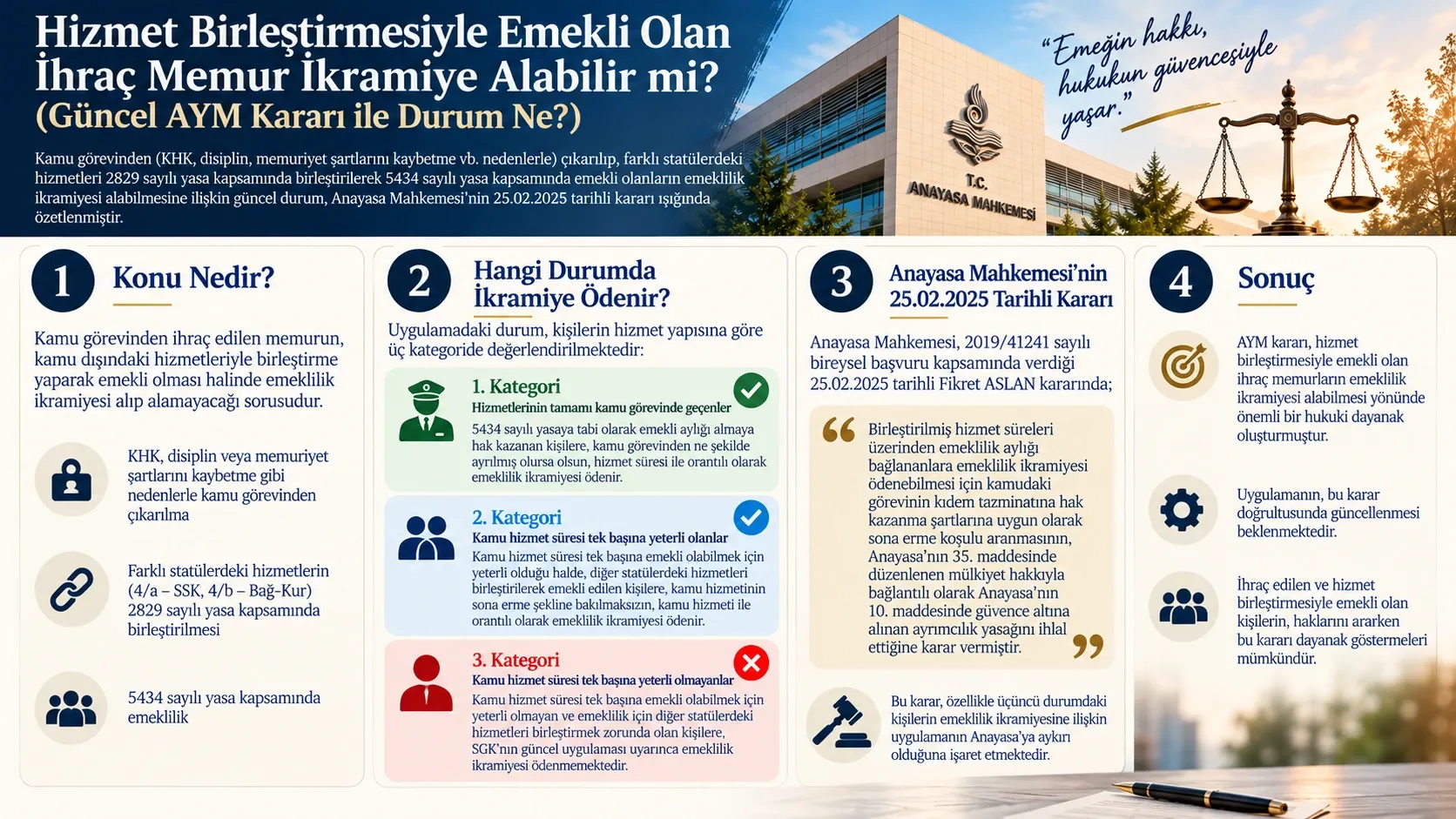
This article examines the current position concerning entitlement to a retirement bonus (emekli ikramiyesi, a lump-sum payment distinct from the monthly pension) for persons dismissed from public service — for example, by a decree having the force of law (KHK), a disciplinary board decision or the loss of the qualifications required for civil service — who retire under Law no. 5434 after their service periods under different statuses have been aggregated under Law no. 2829. These persons may be divided into three categories.
First category: Persons whose entire service was in the public sector. If they become entitled to a pension under Law no. 5434, they receive a retirement bonus in proportion to their length of service, irrespective of the manner in which their public service ended.
Second category: Persons whose public service alone is sufficient for retirement, but who have been retired on the basis of their service outside the public sector — under Article 4(a) (SSK) or Article 4(b) (Bağ-Kur) — being aggregated with, or added to, their public service. Previously, the provisions on severance pay (kıdem tazminatı) in Labour Law no. 1475 were applied to these persons by analogy, and a retirement bonus proportionate to their public service was paid if they met the conditions for entitlement to severance pay. However, dismissal from public service under a KHK or disciplinary provisions was characterised as termination of an employment contract by the employer for just cause. Accordingly, just as a worker dismissed by an employer for just cause was not entitled to severance pay, a public official dismissed by a KHK on that basis was not paid a retirement bonus. This issue gave rise to numerous administrative proceedings. Eventually, case-law established that persons whose public service alone was sufficient for retirement, but who retired on the basis of aggregated service periods, should receive a retirement bonus regardless of how their public service ended. The SGK then changed its practice and began paying persons who retired on the basis of aggregated service periods after dismissal a retirement bonus proportionate to their public service, provided that their public service alone was sufficient for retirement.
Third category (the principal subject of this article): Persons dismissed from public service whose public service alone is insufficient for retirement, but who become entitled to retire when service outside the public sector, under Article 4(a) (SSK) or Article 4(b) (Bağ-Kur), before or after dismissal is aggregated with it. The SGK’s current practice is to withhold retirement bonuses from persons in this category pursuant to the second paragraph of Article 89 of Law no. 5434.
Put simply, a person whose entire service was in the civil service, or whose public service alone is sufficient for retirement despite having aggregated service under other statuses, can receive a retirement bonus even if dismissed, regardless of the manner of departure. By contrast, a person whose public service is insufficient for retirement and who must complete the required service period by paying contributions under other statuses receives no retirement bonus at all if their public service ended in dismissal — even if the shortfall in public service is only one day.
This issue, too, has been the subject of numerous administrative proceedings and individual applications. Ultimately, in its Fikret ASLAN judgment of 25 February 2025, concerning individual application no. 2019/41241, the Constitutional Court of Türkiye (Anayasa Mahkemesi — AYM) established that making payment of a retirement bonus to persons receiving a pension based on aggregated service periods conditional on their public service having ended in circumstances qualifying them for severance pay violated the prohibition of discrimination under Article 10 of the Constitution, taken in conjunction with the right to property under Article 35.
Aggregation of Service Periods and the Retirement Bonus: Infographic
Original Turkish infographic: aggregation of service periods; the SGK’s treatment of three categories; the Fikret Aslan judgment of 25 February 2025, no. 2019/41241; and the legal basis for claims. The article explains these points in English.
View the original Turkish infographic at full size
The Inconsistency in the SGK’s Approach
In relation to the payment of retirement bonuses, the SGK can be seen to apply a practice that constitutes a disproportionate interference with retirement entitlements and the right to property, distinguishing between those whose public service alone is sufficient for retirement and those who must aggregate service outside the public sector with their public service to qualify for a pension.
Consider two persons who entered public service during the same period. One was dismissed after completing the entire minimum public service period required for retirement. The other was dismissed before completing that minimum period and made up the missing contributions by aggregating public service with service under Article 4(a) (SSK) or Article 4(b) (Bağ-Kur) before or after their civil service.
Even if the first person was dismissed by a state-of-emergency decree having the force of law (OHAL KHK), as my client was, that person can receive a retirement bonus calculated as years of service multiplied by gross monthly salary, because the entire service period required for retirement — 20 years/7200 days for women and 25 years/9000 days for men — was completed in public service before dismissal. The second person, however, receives no retirement bonus at all, even after completing the shortfall through service outside the public sector, because the entire service period required for retirement — 20 years/7200 days for women and 25 years/9000 days for men — was not completed in public service before dismissal.
Indeed, since the person in the first situation receives the full retirement bonus despite dismissal by an OHAL KHK, we can readily say that the law does not regard dismissal by such a decree as, in itself, an obstacle to receiving a retirement bonus. The only difference between the two persons is whether their public service alone is sufficient for retirement. A person whose public service alone is sufficient receives a retirement bonus equivalent to a gross monthly salary for each year worked; a person whose public service alone is insufficient receives no retirement bonus, even where the shortfall is only one day.
The Constitutional Court’s Assessment
The dispute described above came before the Constitutional Court in application no. 2019/41241. On 25 February 2025, the Court held that the complaint alleging a violation of the prohibition of discrimination in conjunction with the right to property was ADMISSIBLE; that the prohibition of discrimination safeguarded by Article 10 of the Constitution, taken in conjunction with the right to property safeguarded by Article 35, HAD BEEN VIOLATED; and that a copy of the judgment should be SENT to the Ankara 7th Administrative Court (E.2017/2044, K.2018/386) for a retrial to eliminate the consequences of that violation. As the violation stemmed from legislation — the second paragraph of Article 89 of Law no. 5434 — the Court also ordered that the judgment be NOTIFIED to the Grand National Assembly of Türkiye (TBMM).
In Fikret ASLAN, the Constitutional Court identified the first question as whether persons dismissed after completing the entire service period qualifying them for a pension under Law no. 5434 and Article 4(1)(c) of Law no. 5510 were in a comparable and similar situation to persons dismissed after completing only part of that period. The Court then made the following findings:
“The bonus sought by the applicant, who was dismissed after completing part of the 25-year insurance period required for a pension — 23 years — in public service under Law no. 5434 and Article 4(1)(c) of Law no. 5510, relates to those 23 years. In this respect, the applicant’s situation may be said to be similar to that of persons who are paid a bonus without being required to satisfy the conditions for entitlement to severance pay, despite being dismissed from public service after 25 years. Accordingly, persons who are paid a bonus because they spent in public service the 25 years required for a pension in the present case, despite their dismissal, and persons who spent only part of the required period in public service and completed that period by aggregating service periods — and who are therefore required to meet the conditions for entitlement to severance pay — constitute comparable categories. In other words, persons dismissed from public service after completing the period required for a pension and persons dismissed before completing that period, but after spending part of it under the relevant regime, may be said to be in a similar situation in respect of being subjected to severance pay conditions for payment of a retirement bonus. Their legal positions and statuses are similar. The only difference between them concerns whether they have qualified for a pension — in the present case, 23 or 25 years of service under Law no. 5434 and Article 4(1)(c) of Law no. 5510.
Under the relevant statutory provisions, the primary condition for a retirement bonus is that the person qualify for a pension on the basis of their service covered by the State Retirement Fund. A second condition is prescribed for those whose service under that regime is insufficient for a pension and who complete the period through other insured employment, irrespective of which insured employment came first. Under that condition, their public service must have ended in circumstances meeting the conditions for entitlement to severance pay under Article 14 of Law no. 1475. Requiring this condition of persons granted a pension through aggregation of service periods constitutes a difference in treatment in relation to entitlement to a retirement bonus.”
Having established that persons in similar situations were treated differently, the Constitutional Court focused on whether there was an objective and reasonable justification for the difference in treatment. It expressed its assessment as follows:
“A social state governed by the rule of law must establish a legal order based on justice and equality in society and working life. Under Articles 2 and 60 of the Constitution, the State must create an environment conducive to social security and social justice and enact rules enabling all participants within the same social security institution who are in essentially comparable positions to benefit, in accordance with justice and equity, from any entitlement introduced in the social security field. Enabling persons in the same situation to benefit from statutory rights on the same basis is also a requirement of the equality principle expressed in Article 10 of the Constitution (AYM, E.2013/111, K.2014/195, 25/12/2014).
The right to social security is the most important of the social rights dependent on State support. A retirement bonus is a payment made, pursuant to the principle of the social state and to ensure stability and continuity in working life, to public employees who qualify for a retirement, old-age or disability pension. It falls within the right to social security provided for in Article 60 of the Constitution. The legislature has the power to regulate the amount and payment conditions of retirement bonuses, provided that it respects constitutional principles and the requirements of equity and the public interest. However, when discharging its duty to provide social security under Article 60, the legislature may not rely on that power to introduce arbitrary retirement bonus rules or rules causing inequality among the beneficiaries of that right (AYM, E.2013/111, K.2014/195, 25/12/2014).
It is also clear that public authorities enjoy a certain margin of appreciation in determining whether, and to what extent, different treatment is required in similar situations. There is no doubt, however, that this discretion is subject to limits arising from the prohibition of discrimination in conjunction with the right to property. Public authorities whose interference with property rights results in different treatment of persons in the same position must be able to provide reasonable and objective grounds justifying that difference (Bedrettin Morina, § 49). Thus, although determining retirement bonus conditions falls, in principle, within the discretion of public authorities, the interference must not be applied in a discriminatory manner without reasonable and objective justification. Taken as a whole, the foregoing considerations show that the statutory provision is based on the Constitutional Court’s annulment judgment that paved the way for payment of bonuses to persons who had left public service. Having regard to objectives such as ensuring stability and continuity in public service, the sustainability of the social security system and actuarial balance, the legislature has discretion to differentiate, in relation to payment of retirement bonuses, between persons whose entire service required for a pension falls under Law no. 5434 or provisional Article 4 of Law no. 5510 — in other words, those who can retire without aggregating service periods — and persons who can retire by aggregating service periods. It cannot be said that prescribing different conditions for the second category lacks objective and reasonable justification.”
As can be seen, the Constitutional Court concluded that it could not be said that different treatment of persons able to retire without aggregating service periods and those able to retire only by aggregation lacked objective and reasonable justification. It then examined whether that difference in treatment was proportionate. Under this heading, the Court stated: “A reasonable relationship of proportionality must be established between the legitimate aim pursued by the difference in treatment and the applicant’s individual interest in enjoying the right to property. Compared with the public benefit to be obtained when the intended aim is achieved, the burden imposed on the individual by the difference in treatment must not be excessive or disproportionate (Ayşe Tezel and Others [Plenary], application no. 2018/14186, 20/10/2022, § 88). The equality principle, a constitutional safeguard, requires that different treatment should not impose a disproportionate burden on the person concerned, even where it has an objective and reasonable justification (Mehmet Fatih Bulucu, § 77). Although the legislature has discretion to provide for a difference in retirement bonus payments between persons whose entire service falls under Law no. 5434 or provisional Article 4 of Law no. 5510 — in other words, those who can retire without aggregating service periods — and those who retire by aggregating service periods, the difference between comparable groups must be proportionate. Persons whose entire service falls under Law no. 5434 or provisional Article 4 of Law no. 5510 receive their retirement bonus in full when dismissed from public service, whereas those retiring by aggregating service periods under the second paragraph of Article 89 of Law no. 5434 receive no retirement bonus at all. This remains so even where the service under Law no. 5434 or provisional Article 4 of Law no. 5510 is very long and the service under other legislation aggregated to complete 25 years is only one month. Indeed, in the present case, the applicant had 23 years of service under Law no. 5434 or provisional Article 4 of Law no. 5510 and aggregated only two years of employment under other legislation, yet received no retirement bonus, even proportionately to the service under the former legislation. By contrast, persons dismissed from public service for the same reasons who completed 25 years under that legislation received their retirement bonus in full. It has therefore been concluded that the difference between the comparable groups is manifestly disproportionate.” Through these assessments, the Court established that the difference in treatment was disproportionate even though it had an objective and reasonable justification.
The Constitutional Court thus made clear that the difference in treatment was disproportionate, notwithstanding an objective and reasonable justification, and violated the prohibition of discrimination in the context of the right to property.
Does the Constitutional Court’s Individual Application Judgment on Retirement Bonuses Apply to Everyone?
Although it is debated whether judgments on individual applications have res judicata effect and are binding only on the parties, it is clear, when the AYM’s judgment is considered as a whole, that it has the character of a pilot judgment and directly calls on the TBMM to amend the law and on the lower court to refer the relevant statutory provision to the AYM for constitutional review. The findings in Fikret Aslan, no. 2019/41241, have been reiterated in similar individual applications before the AYM, including İrfan Yazıcı, no. 2020/9559, and Mehmet Uzdu, no. 2020/6111. The AYM has therefore developed consistent case-law on this issue.
Likewise, in some proceedings concerning the same issue, courts have stayed proceedings and referred the second paragraph of Article 89 of Law no. 5434 to the Constitutional Court for annulment through the constitutional referral procedure. Examples include the stay ordered by the 11th Administrative Litigation Chamber of the Ankara Regional Administrative Court on 24 December 2025, E.2025/875, and the stay ordered by the Ankara 19th Administrative Court on 15 January 2026, E.2025/1427. The judgments and referrals expressly state that the unconstitutionality stems from a structural problem and that the problem can be resolved only by amending the legislation giving rise to the violation.
An Administrative Court Precedent Ordering Payment of a Retirement Bonus
In its recent judgment in an analogous case concerning the same subject matter, E.2025/1395, K.2026/273, the Ankara 14th Administrative Court stated:
“In these circumstances, although Article 14 of Law no. 1475, to which Article 89 of Law no. 5434 refers, indicates that a retirement bonus cannot be paid, the Constitutional Court’s above-mentioned judgment finding a violation must be taken into account. Where service covered by the State Retirement Fund is sufficient on its own, a retirement bonus is paid regardless of the manner in which service ended. Where that service is insufficient on its own for retirement, however, requiring it to have ended in circumstances qualifying for severance pay imposes a disproportionate burden on the claimant in relation to entitlement to a retirement bonus and violates the prohibition of discrimination in conjunction with the right to property. It has therefore been concluded that the administrative act rejecting the claimant’s request for payment of a retirement bonus is unlawful.
Furthermore, under Article 125 of the Constitution, ‘The administration shall be liable to compensate for damage resulting from its own actions and acts.’ Since the contested administrative act is unlawful, the retirement bonus of which the claimant was deprived as a result of that act, corresponding to actual service under Article 4(1)(c) of Law no. 5510 (Law no. 5434), must be paid together with statutory interest accruing from the date of the request to the defendant administration.” On these grounds, the court annulled the contested administrative act.
Should Administrative Courts Give Priority to Constitutional Principles or to a Statutory Provision That Conflicts with Them?
In pending proceedings, insistence by administrative courts on applying a statutory provision whose incompatibility with the Constitution has been established by a Constitutional Court judgment would violate the equality principle, one of the fundamental requirements of the rule of law, and would be contrary to legitimate expectations and equity. Administrative courts should, in line with the AYM’s judgment and the constitutional right to social security and principle of equality, recognise that claimants who retire on the basis of aggregated service periods are entitled to a retirement bonus corresponding to their time in public service.
Article 11 of the Constitution, which establishes the binding force of constitutional provisions, and Article 138, which requires judges to resolve disputes by giving priority to constitutional provisions, oblige judges to decide in accordance with the Constitution. In this context, Article 152 also places judges under a duty to examine whether the statutory provision to be applied in the case is constitutional. From this perspective, constitutional safeguards should take precedence over Laws nos. 5434, 2829 and 1475.
Can Proceedings Be Stayed?
If administrative courts do not or cannot directly order payment of the retirement bonus, they should, as encouraged in the AYM’s judgment, refer the unconstitutional Article 89 of Law no. 5434 to the Constitutional Court for annulment through the constitutional referral procedure, or await the outcome of referrals already pending before the AYM on this matter.
These referrals, which are currently before the Constitutional Court and are highly likely to result in annulment of the statutory provision, should be taken into account, as in the cited administrative court precedents, and courts should refrain from deciding cases on the basis of a statutory rule whose unconstitutionality has become clear.
Do Some Administrative Courts Still Dismiss Claims Despite These Developments?
Yes. Despite the reasoning in the AYM’s Fikret ASLAN judgment, some administrative courts uphold the SGK’s refusal of retirement bonus claims under the second paragraph of Article 89 of Law no. 5434, rather than giving effect to the constitutional principles concerning the right to social security. If the Constitutional Court grants the request for annulment of that paragraph through the constitutional referral procedure, even while these cases are pending on appeal (istinaf) or appeal on points of law (temyiz), this will lead to the administrative proceedings turning in the claimants’ favour.
What Should People Denied a Retirement Bonus Do?
There is no doubt that the Constitutional Court’s Fikret ASLAN judgment and subsequent similar judgments have created a new legal situation in this field. To secure this constitutional entitlement, it is essential for persons dismissed from public service who retire by aggregating service periods to rely on this new legal situation when asking the SGK to pay a bonus corresponding to their public service, and to bring administrative proceedings within the statutory 60-day period in response to an express or tacit refusal.
📞 Legal Support and Contact
Has the SGK rejected your request for a retirement bonus corresponding to your public service, even though you retired by aggregating service periods? In light of recent Constitutional Court and administrative court precedents, it is possible to recover your retirement bonus through legal proceedings.
You can seek support from our specialist team to avoid missing filing deadlines and to defend your constitutional rights with the appropriate legal arguments. Contact our law firm for detailed information and legal advice on managing the process, making an administrative application and bringing an action for annulment.
Judgment Source and Related Links
AYM, Fikret Aslan — application no. 2019/41241, 25 February 2025 (Turkish original)